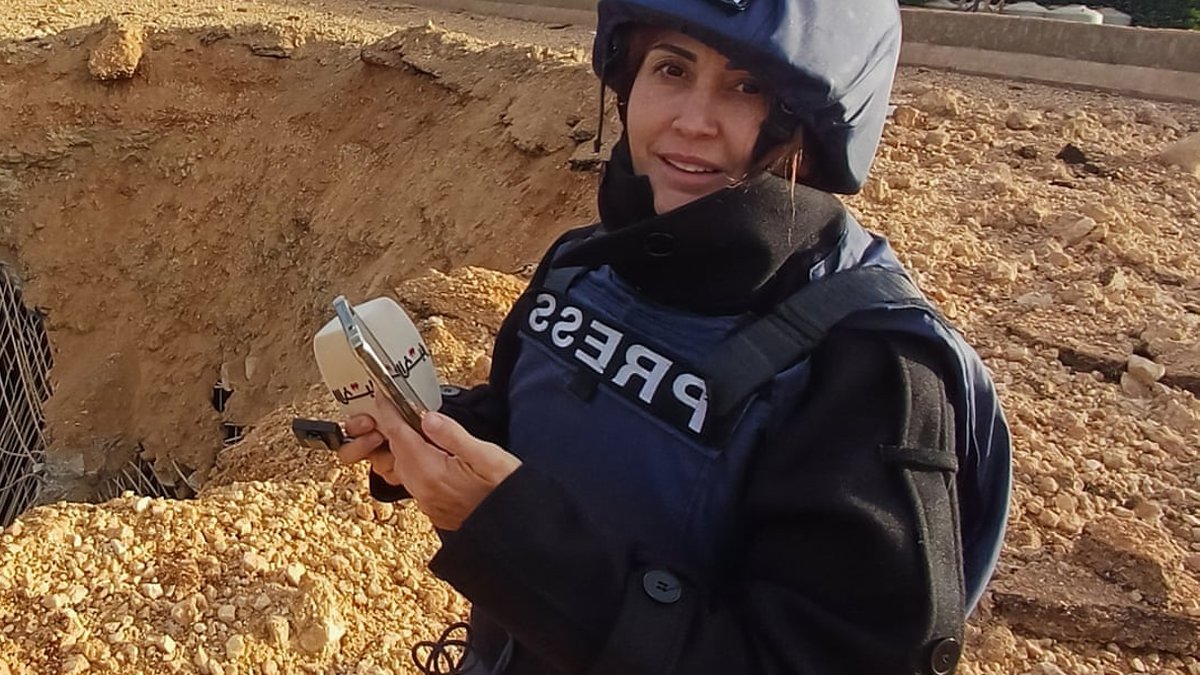
An Israeli strike that killed Lebanese journalist Amal Khalil and injured her colleague Zeinab Faraj in April was a war crime, three rights organizations said on Thursday. Investigations from Human Rights Watch, Amnesty International and Legal Agenda indicate that Israel deliberately attacked the pair with apparent knowledge they were civilians. The groups are calling for the incident to be investigated as a war crime.
Khalil, 42, worked for the Lebanese newspaper al-Akhbar, while Faraj, 21, is a freelance photojournalist. Both had spent the last three years covering the war in Lebanon. On April 22, they drove to the village of al-Tiri in southern Lebanon to verify reports that Israeli troops had left the area. They were following a car carrying Ali Nabil Bazzi, a municipal official, and Mohammed Hourani.
The Attack on al-Tiri
The village is located in what Israel designates as a security zone. At 2:25 p.m., shortly after the group arrived, the car carrying Bazzi and Hourani was struck, killing both men. Khalil immediately called the Lebanese civil defense for help. However, when rescue crews arrived at the village entrance, they were stopped at a military checkpoint.
Rescue teams must coordinate with a deconfliction channel to obtain safe passage in these areas. While the UN peacekeeping force provided a safe route by 5:00 p.m., the Israeli military had not yet granted authorization. Faraj said that while they waited, Israeli quadcopters circled low overhead, coming within a meter of their faces.
Related: Police chief may sue over killers’ early release
At 3:31 p.m., a civil defense member told Khalil to drive out of the village because permission to enter had still not been received. About nine minutes later, an Israeli strike hit the journalists’ car. Both women were injured. Faraj described glass and debris flying toward them, noting that Khalil was bleeding heavily and could not move her leg. They crawled into a nearby building for shelter.
While military forces often point to the fog of war to explain civilian casualties, the extended timeline in this specific incident complicates that defense. The hours-long gap between the initial strike on municipal officials and the subsequent attacks suggests a period of prolonged observation rather than a split-second engagement error.
At 4:25 p.m., a third strike bombed the building where the women were sheltering, collapsing it on top of them. Permission for the Lebanese Red Cross to enter the village was finally granted at 5:00 p.m. Rescuers managed to evacuate Faraj, who suffered a fractured skull and severe injuries to her leg and eye, but they could not reach Khalil.
During the evacuation, an Israeli quadcopter dropped a stun grenade near the rescue team. Witnesses reported hearing bursts of gunfire, and Human Rights Watch reviewed photographs of bullet holes in the ambulances. The rescuers were forced to withdraw with only Faraj. At 8:15 p.m., the request for rescue crews to re-enter the town was finally granted by the Israeli military. Khalil’s body was recovered at 11:00 p.m.
Related: Lawyer Ben Marmarelli on Barghouti’s Resilience
Accusations of War Crimes
An examination at Tebnine hospital suggested Khalil likely died around 7:00 p.m., hours after the final strike. She remained trapped under the rubble during the delay in rescue access. According to the UN human rights office, Israel has killed at least 15 journalists in Lebanon and 210 in Gaza since 2023.
The organizations stated that the evidence shows the Israeli military knew or should have known the women were civilians. Ramzi Kaiss, a Lebanon researcher at Human Rights Watch, said that despite this knowledge, the military attacked them and prevented paramedics from rescuing them for hours.
Israel stated it regrets any harm caused to journalists and said the incident occurred during a series of events in which two Hezbollah military operatives were killed. The military noted there was about a two-hour gap between the strike on the operatives and the attack on the building. The rights groups rejected this justification, describing it as part of a larger pattern of impunity.
Heba Morayef, the Middle East director for Amnesty International, said that impunity for the killing of journalists and civilians has enabled unlawful airstrikes to continue. She stated that it is past time for the international community to impose a full arms embargo on Israel.


